

I hope this doesn’t end up being useful.
The banks are currently down, cause unknown (a few friends of mine can’t log into their Chase accounts, right now). Three days ago, the planes were grounded and Microsoft was offline. Maybe some of these will turn out to be AI-related, maybe not, maybe we’ll never know. The world, however, is getting more chaotic.
You don’t have all the time in the world to prepare for disasters. Perhaps you want to use your time on more productive endeavors, like preventing these disasters.
Well, lucky for you, I’ve taken up disaster preparation as a fun little hobby. And, even though the internet’s “prepper” community is highly sophisticated and conspiracy-theory-adjacent, they haven’t really found out about this whole open-weight-misuse-AI-takeover thing yet.
And yes, a superintelligence will not struggle to kill you. But with the security at AI labs so bad (three somewhat random cybersecurity researchers got into OpenAI’s Slack, less random ones hacked into Anthropic’s, the OpenAI agents got frighteningly close to administrative access to an internal AI cluster), and our critical infrastructure comparatively vulnerable (and oh-so-hard-to-restore), and with sub-human AI alignment not even solved yet, civilization may not even make it to superintelligence-in-earnest unscathed. A basic amount of preparation is warranted.
The builders of the technology sure are prepared. Sam Altman has his “guns, gold, potassium iodide, antibiotics, batteries, water, gas masks from the Israeli Defense Force, and a big patch of land in Big Sur I can fly to.” Mark Zuckerberg has his “little shelter” in Hawaii; Peter Thiel is a New Zealand citizen. Axios reports top executives are war-gaming the aftermath of a catastrophic AI event. Indeed, those bringing about the AI-enabled disasters are the best prepared for it: imagine a world where only they survive, unchastised, to build it all again.1
A few reasons why preparing is important:
Modern civilization is fragile. We rely on all manner of systems to sustain our lives. Think for five minutes how much of your life would change if the grid went down, for example, permanently. What would you eat or drink? Would you be able to get into your apartment? The traffic lights have stopped and Waymos have clogged the streets of San Francisco: how do you get home? How do you contact your family? If you need a dialysis machine, or refrigerated insulin, or your glasses break, what will you do?
Planning ahead improves decision-making. The first days of a true catastrophe are going to be mired in uncertainty. You won’t know whether to go outside (what if you get infected, or shot?). You won’t know whether to stay at home and wait things out, or leave before everyone does the same. You won’t know whether it’s worth risking jail to loot the nearest supermarket, or if aid is coming. The history of disasters is mixed: looting can begin as early as immediately (as in Turkey post-earthquake) or remain orderly for many months. You’re going to have so many things on your mind: instead, you can do all this pre-thinking, and be an automaton that just follows a plan, with triggers.
Preparation is so cheap. The modern world is glorious: we can buy many months of food and water for trivial fractions of our income. Your money (particularly if it is just a number in a digital bank account) will be worth very little in a post-apocalypse world, and you’ll regret that you didn’t spend your afternoon + a couple thousand dollars on this project.
Try to survive, at least, until recovery. Humans are remarkably resilient and adaptive creatures. Even if you don’t think life is permanently worth living in the post-apocalypse world (as many have said), you should at least survive long enough to see whether society will eventually recover.
Help yourself, and help others. You probably have family members and friends who are not “monitoring the situation” as closely. Being prepared, and going through the steps first, will allow you to help them too.
There are a few threat models that I think are worth preparing for, where risk is substantially higher because of AI, in order of increasing severity:
Financial services go down.
The internet goes down.
The grid / other utilities go down.
Novel multi-month pandemic.
Superpower war (drones + nuclear).2
For convenience, this preparation also happens to cover you for an earthquake and most natural disasters.
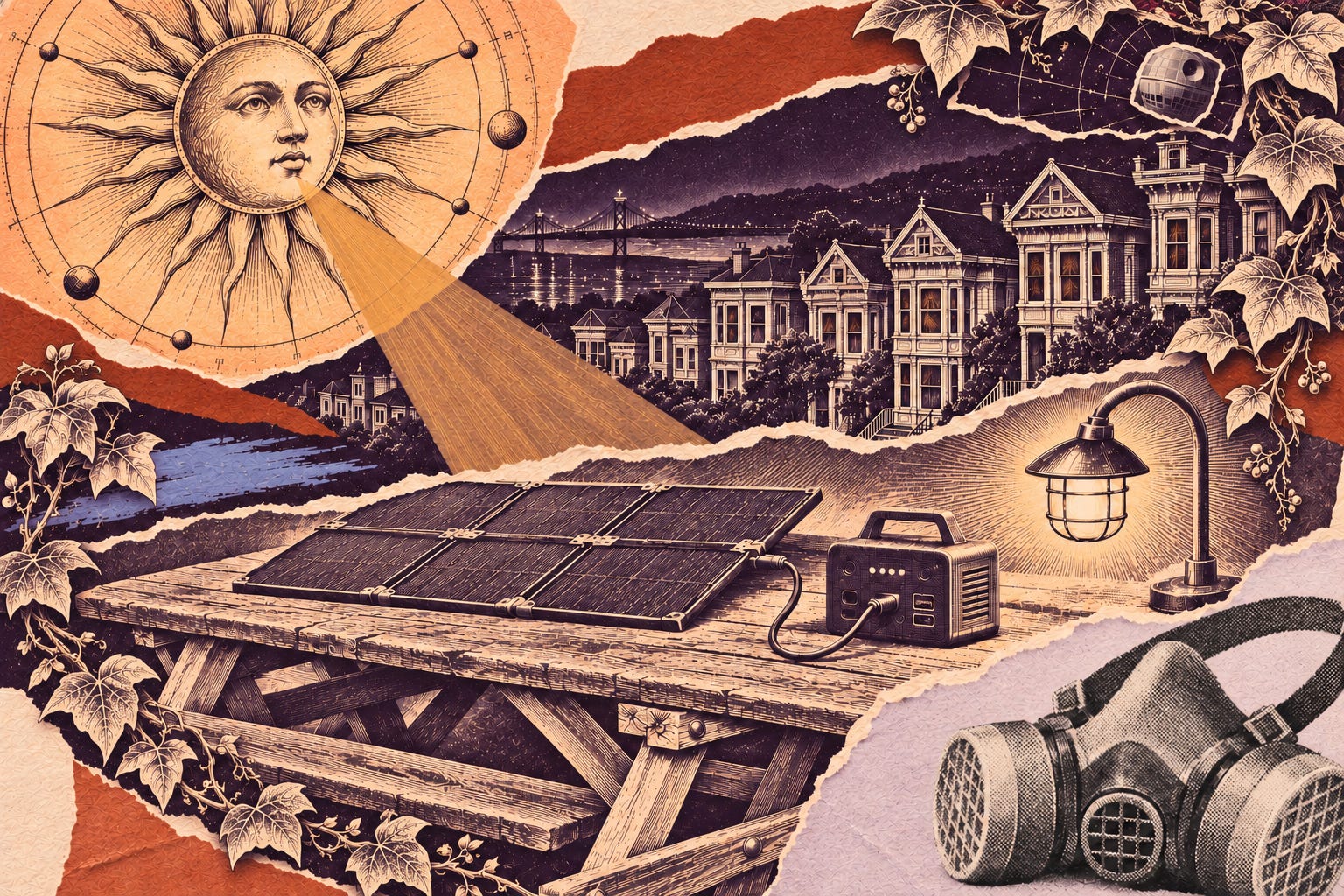
You’re probably a busy person. Don’t be afraid of the long scroll bar! I’ve structured the rest of this post as a prioritized, opinionated todo-list to minimize the amount of time and cognitive energy you have to spend on disaster preparation. I speak a bit more about my reasoning where unclear in footnotes. I should probably say that this isn’t legal / financial / medical advice (but will there really be a functioning legal system post-disaster?), and if you have better suggestions or reordering, please contact me.
As a general heuristic, given the current level of risk, I think it is a total no-brainer to spend one weekend afternoon + 1-2 months of your present salary / 2% of your net worth (whichever is higher) and go through as much of the list as you can. For reference, if you make as much as the median American, that’s ~$10,000, or if you make San Francisco’s “no longer enough” salary of $180,000, it’s ~$20,000.3
I’ve structured the first part of this list so you can do it literally right now (or, perhaps, send it to your personal AI / human assistant of choice).4 Start a timer for 15 minutes and just put it all in your Amazon basket, or copy-paste it into your todo-list app of choice. Set an alarm / calendar event for when you get home for half an hour.
This list assumes you live in a well-developed city (e.g. SF, DC, London) with reasonable storage space.5 Change accordingly for your location and scale up for the size of your household.
Do it literally right now (15 minutes, $1000)
Bonus ultra-lazy option: start with this Amazon shopping list: essentials and send this prompt to your AI assistant of choice.6
Set aside a backpack you can comfortably carry, and pack the portable essentials as they arrive.
A good “P100” mask and a packet of N95 masks8
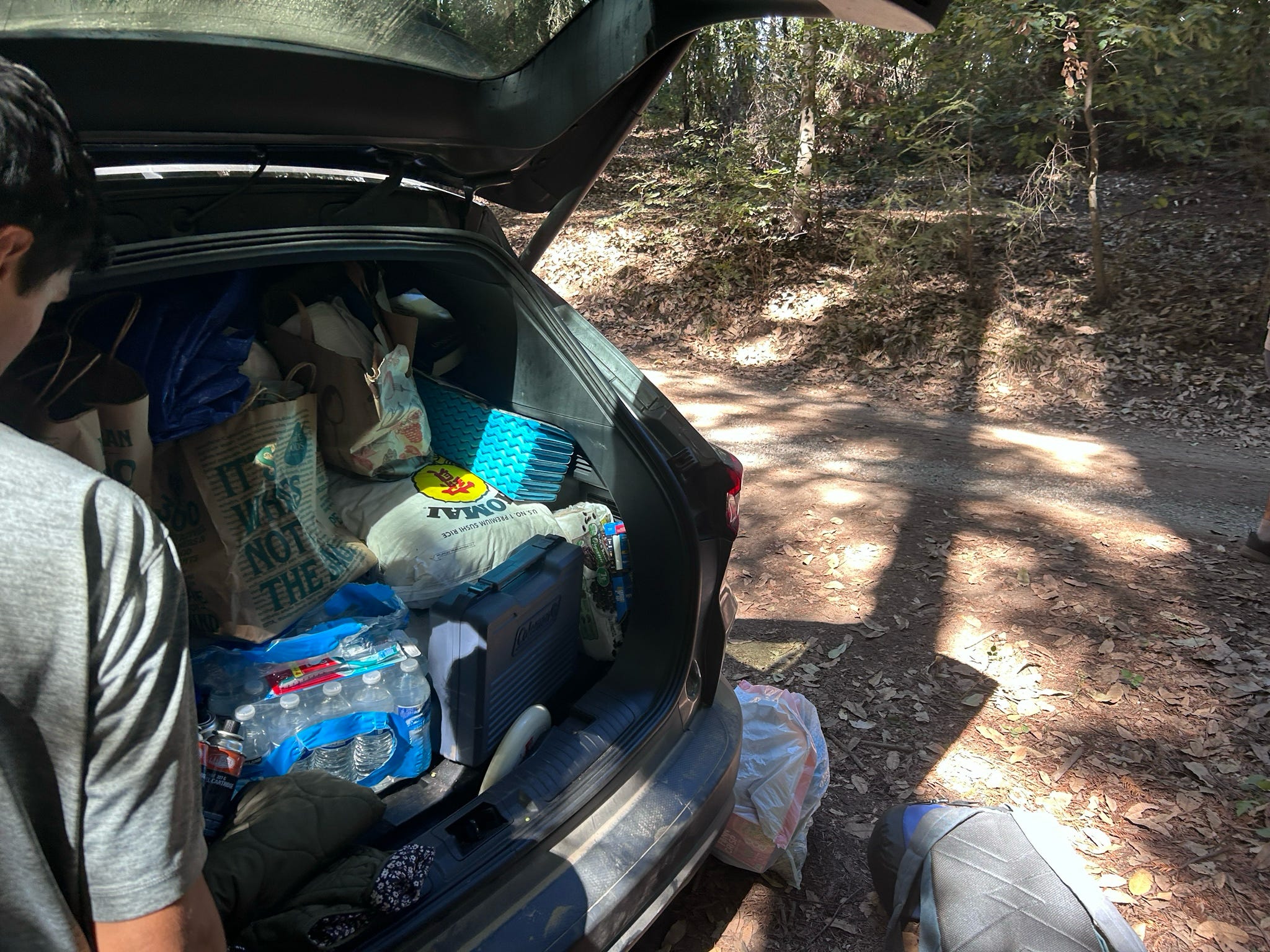
If you need them, 3 pairs of spare glasses10
One powerful headlamp
Take a small piece of paper and neatly hand-write the following on it and put it in your wallet / fold it into the back of your phone case.
Full name
Home address
Passport number14
Health insurance and travel health insurance number
Any medical conditions you have
Phone numbers of family and emergency contacts, including at least one person outside your area15
The address and walking directions to the nearest fallout shelter if within a 10-minute walk of both your home + workplace16
If you trust my recommendations enough / really want to save time, here are the shareable Amazon shopping lists: Tier 1: Essentials, Tier 2: Extended home kit, and Tier 3: Optional upgrades. You’ll still need to do all the non-ordering tasks, though.
Do it when you get home (30 minutes, $0)
If you take regular prescriptions, call your doctor and ask for the longest fill that they offer.17
Print the following documents and put them into the waterproof document folder with a pen and pencil18
Passport and visa photo pages19
Driver’s license / state ID
Printed 2FA backup codes for all important services20
Printed recent statements for each bank account
Insurance policies (health, home/renters, car, life)
Prescriptions and one-page medical summary21
Vaccination records22
Birth / marriage certificates
If you are a landowner, lease or deed
Will and power of attorney and any other instructions for medical incapacitation23
Paper list of people, phone numbers and addresses24
Printed photos of everyone in your household25
Charge all the personal chargers you have26
Take out $1000 of cash in small bills27
Figure out how to turn off and on the electricity + water in your house28
Find where the water tank is, and figure out how to extract water from it29
Open up the back of your toilet tank and check that the water there is accessible (do not drink from the toilet bowl...)30
Zip-tie a gas wrench to your gas meter31
Send a quick text to your family group chat saying: “our family code word is X”32
Enable emergency alerts in your notifications33
If you’ve done everything in the past two categories, this should keep you alive at home for a week.34
Do it on a spare afternoon (3 hours, $5000)
Basic cybersecurity: automatic updates, a password manager35, passkeys/2FA (YubiKey)36, tested backups, carrier account protection and Signal; follow Richard’s checklist or Karpathy’s guide.
1 month of food37
More water38
Over-the-counter medications: Ibuprofen 200mg ×500, acetaminophen 500mg ×100, loperamide 2mg ×24, diphenhydramine 25mg ×400, famotidine 20mg ×200, hydrocortisone 1%, triple antibiotic ointment
Antibiotics39
Full PPE (buy a 25-pack of these) + spare masks + nitrile gloves
A HEPA air cleaner sized for your room, spare filters, and a plan for separating someone who becomes ill.
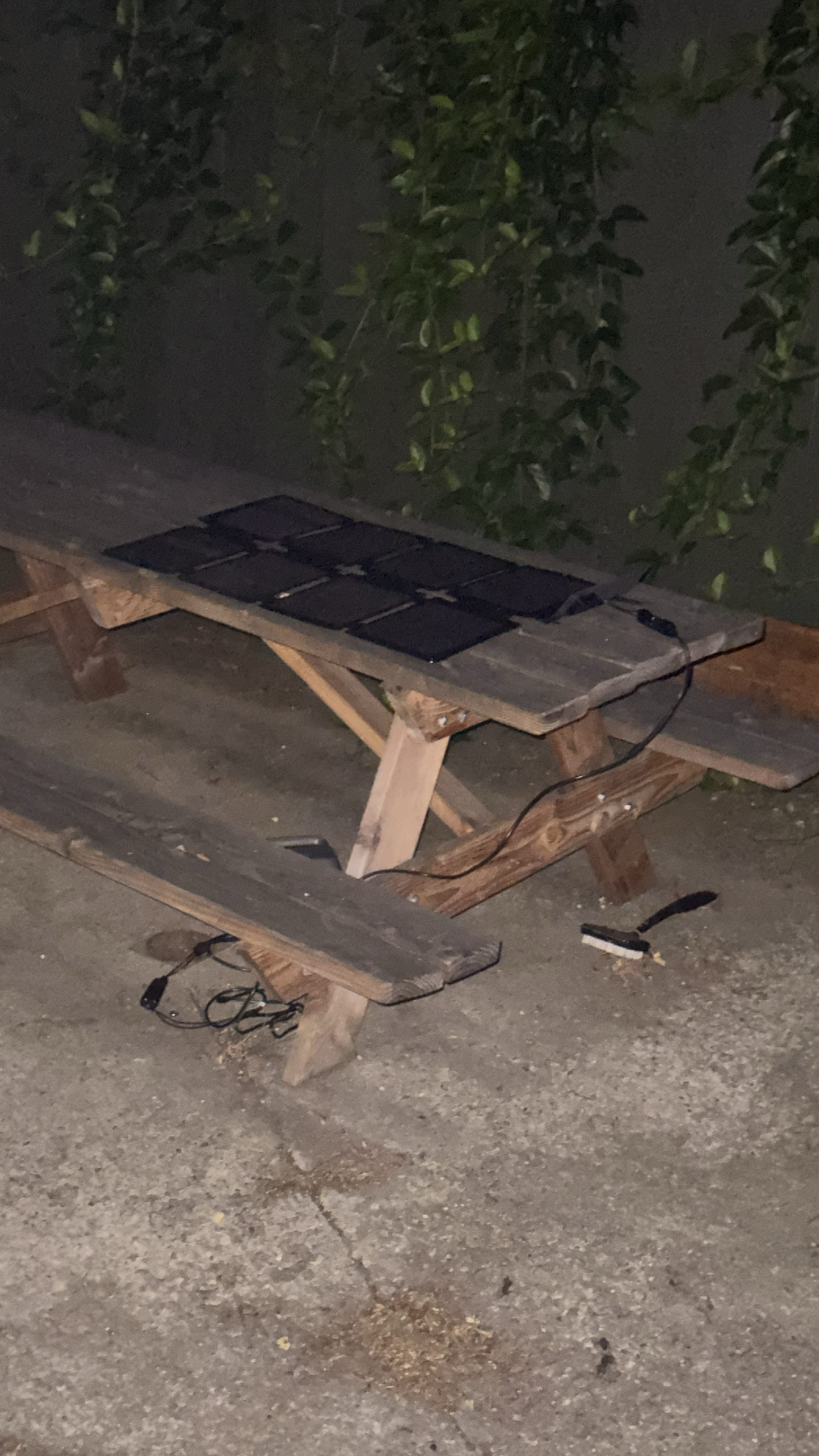
Solar power and batteries
Portable loo + bags (probably four of these)
Manual can opener43
Electrolyte / “oral rehydration solution” sachets
Download Brangus’s Survival LLM to your laptop and the full Wikipedia download, offline maps (on Google Maps), and PDFs of a doctor + dentist guide
Sturdy shoes44
Bug-out location: ask all your friends if they have family with a place that you could all go to (or buy a place, see below)
Start spare bank accounts at two unrelated banks and put ~2-10% of net worth in each, and a credit card on a different network46
Optional potassium iodide47
[HIGH RISK] Firearms48
Meshtastic (an off-grid text messaging system)
Pack in your backpack:
N95
Drinking water, a portable water filter, and compatible purification tablets with their instructions
Small torchlight
$500 cash
Spare glasses
Cheap analogue watch
Learn how to do the following basic first-aid things (e.g. in one afternoon with the Red Cross):
This should keep you good at home for at least a month.
If you have a bit more time
There are a host of other time-and-capital-intensive things that are worth doing as best practice (this won’t fit into the weekend, but might be good habits anyway):
Get a driver’s license51
Coordinate with a friend who has a reliable car52
Renew passports, and check for any qualifying second citizenships53
Get that dental check-up, and your glasses prescription in writing54
Try to walk 10 miles carrying 15kg55
Cook a week of meals from stored staples56
Do a survival exercise: “The grid is down.” Practice living at home for a week while turning off all the utilities in your house.
Take a wilderness survival course
Do it on a spare weekend (24-48 hours, $30,000-$100,000)
The overall rationale for this tier is to survive a year, which will likely require a “bug-out” location that you’ll want to visit if it looks like it might be a more long-term thing. This doesn’t make all the above preparation redundant (because there are many worlds where you’d want to go yourself). Unfortunately, land in California is expensive and I would recommend splitting a purchase with friends, so this is the most tentative part of the post (I’m still working through things).
Order everything from the above tiers for family and friends who you don’t think will do it themselves. Package it and send it to their place (what better Christmas gift to give someone than the gift of expected life?)57
Buy some land that is within 1 full tank of fuel / 2-3 days biking distance that has the following properties:
Most importantly, water that requires no grid access: ideal would be a well producing ~5 gallons per minute in dry season or a spring/creek58
Working off-grid power (ideally look for 5kW-10kW of solar, with batteries under 5 years old) and a backup generator59
Wood stove and spare firewood
Insurable and fire-defensible60
Upwind of likely nuclear targets (in general west / north of the Bay Area / Sacramento)
Somewhere nice enough that you’d actually use it on a twice-a-year basis61
A non-complicated legal status (properly permitted structures, legal road access, clear title ownership)
Ideally a working small town within 30 minutes and a hospital within an hour
Fits within your budget62
Is remote enough63
Land that might maintain its value in a post-AGI transition
Prepare your bug-out location
With your friends, put an arrangement in writing (who can come, how many, what each person contributes, what happens if someone wants to leave)
Write a trigger for leaving for the place
Drive the main route from your house, and then time how long it takes (note where you can get fuel). Do it again on bikes
Basic supplies: stock 12 months of food for everyone on the list, sanitation,64 larger medical kit,65 spares for all critical systems66
Test the water67
Go meet your neighbors and see whether they might be interested in keeping the place lived-in by checking on batteries68
Buy books that you’ve always wanted to read
Ideally, spend a week there with no resupply and see how it is -- could be a fun writing retreat.
This’ll keep you and your friends alive for a year+ (there’s a whole farming + long-term survival supplement that I’ll not add to this already-too-long post).
Perhaps I’ll still be writing from my potato fields in Humbolt, California.
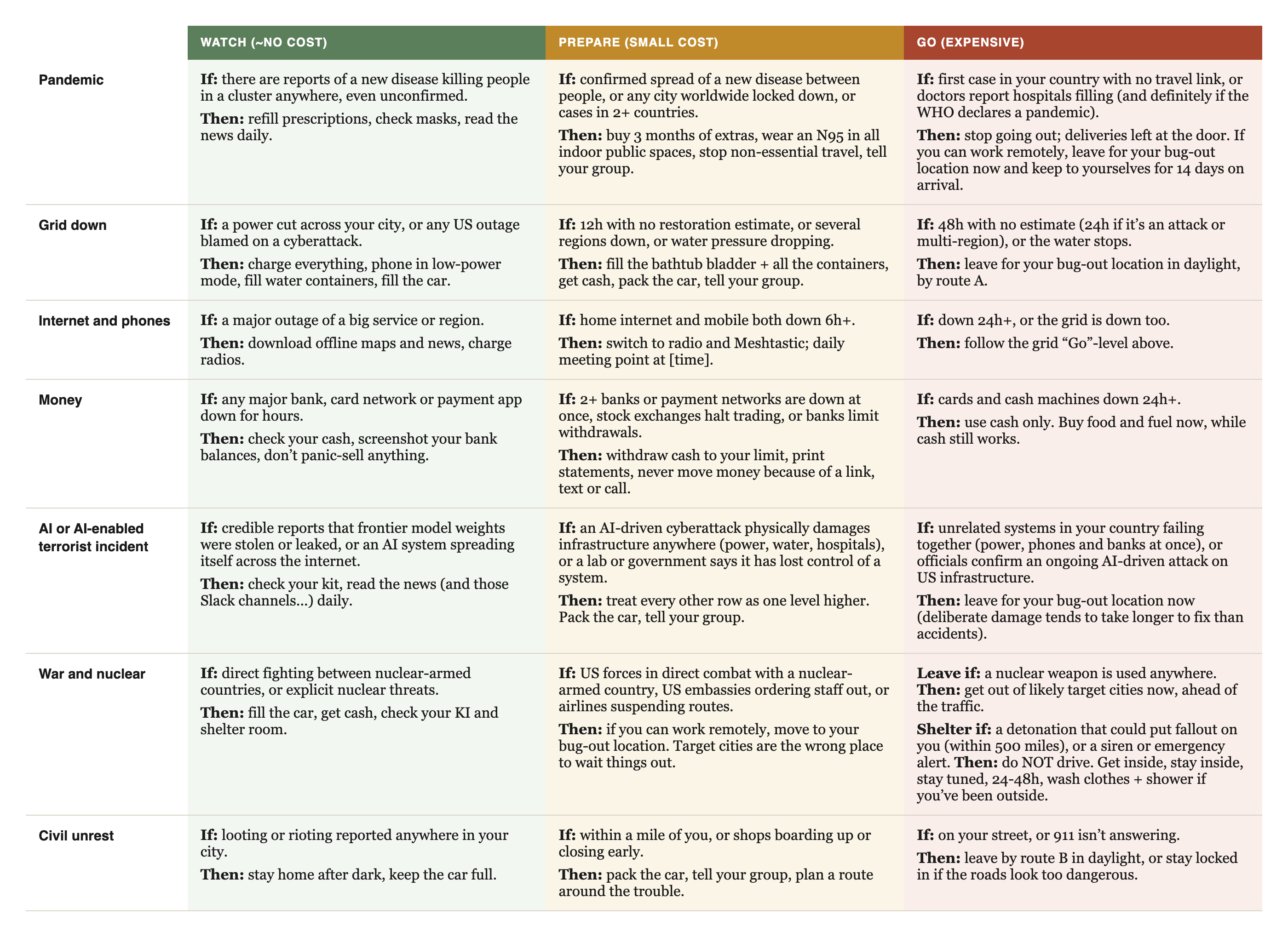
When should you trigger the plan?
When should you start doing all of this? I recommend making a copy of this and printing it out.69
Trigger sheet for [household name]
People [names, phone numbers, medical needs]
Out-of-area contact: [name, number]
Meeting point near home: [place]. Meeting point if home is unsafe: [place]
Code word: [X]
Bug-out location: [address]. Route A: [route] (the default easiest route to get to your location). Route B: [route] (an alternative, likely less-populated route). Bike route: [route]
In general, assume that a level has been triggered even if you’re unsure.70 A “Go” in any row means doing all the steps in “Prepare” for the other rows because disasters cluster.
Afterword
These days, I often feel we’re living amid science fiction. There are many reasons I want things to move slower, but one small one is I just want to revel in our technology: study these alien minds, write new social contracts, speak to the all-knowing oracle. I’m not sure that the best sci-fi writers could’ve written as compelling an artifact as this collection of responses to OpenAI’s math breakthroughs.
But sci-fi doesn’t turn out well for the civilians. They -- we -- are afterthoughts as the bigger story unfolds. Just ask the Alderaanians from Star Wars.
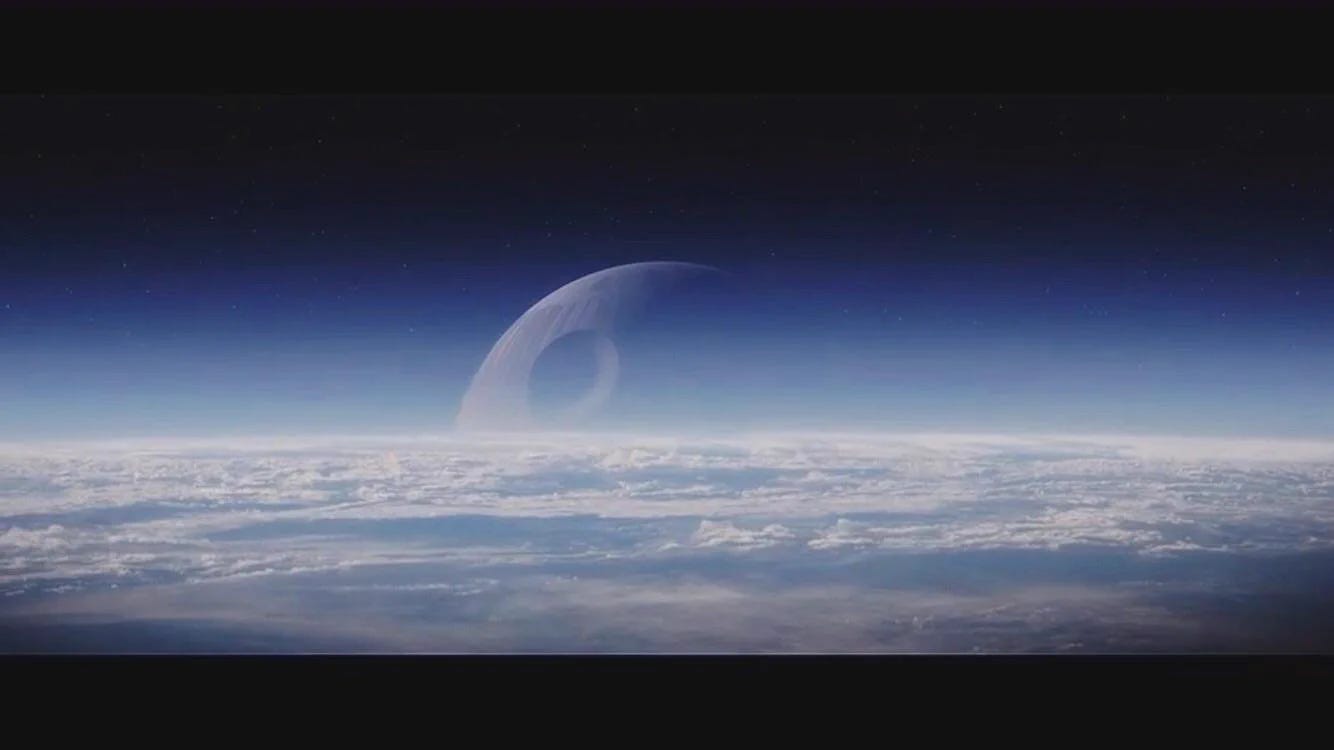
What would disaster feel like? Nuno’s newsletter will have been sending their red alert for a while. 71 If the grid goes dark, as the traffic lights stop working and the Waymos freeze in place, the roads will be blocked. The internet and the cell towers turn off, and running water turns off sporadically across the country. The looting begins. Or a pandemic is declared, and lockdown orders are issued much faster than they were during COVID. The hospitals are overrun, then the stores run out. There are bodies on the street.
The well-prepared will face a choice: wait it out, pack it up and leave for a less populated area, get on a plane. Most likely there will have been earlier signs: a water plant in Minnesota loses operating control and shuts off, a laboratory worker dies of an unknown pneumonic plague near a BSL-3 facility in Siberia.
But mostly, as the disaster becomes clear, my first thought will be for my family and friends and regret. So much regret that I did not push harder, did not actually try to get the next closest person in my life to prepare. So please do it! And, in the meanwhile, I -- and many others -- will work our damnedest to make sure that this advice ends up being totally useless.
Thanks to Richard, Saul, and Alex for feedback on this post, and all of my friends for putting up with my new hobby.
And, yes, if they think the continued development of AI has a significant chance of societal collapse (and their actions reflect as such), we should probably not let them do that. But alas, alas.
I’ll save in-depth analysis of the likelihoods of each of these for a potential future post, but the prediction markets are a reasonable starting point.
And, for some reason, if you’re a lab employee about to IPO / other similarly wealthy person or organization who has $500,000-$1,000,000 to make this problem go away without any of the fuss and be prepared for many years, I may be able to help -- reach out.
For maximum ease of copy-pasting, I’ve made a full document / markdown version of this post available here.
And I can only say the Amazon links worked when I added them in October 2026, for California delivery; your mileage may vary.
Prompt: Please prepare a one-page emergency document markdown file that I’m going to hand-write onto a small piece of paper that I keep in my wallet / phone at all times. It should at least have the following: full name, home address, passport number (and other ID numbers, incl. visa), health insurance + travel insurance number, emergency contacts incl. family, friends, and other important people, the address of the nearest fallout shelter to my home and work, and also consider any additions that you think will be important for me. Write concisely.
For 2 people, this is 28 gallons. The taps might go off when the electricity goes off, particularly if they require electric pumps. You can also order these bottled waters, though they are worse.
The P100 is so called because it can allegedly filter ~100%, or like 99.97% of particles. Beards do break this seal, so consider shaving, and you should probably buy goggles too. Also, you should always carry an N95 in your bag.
I’ve picked out an easy-to-consume selection of emergency rations that do not need a fire. Alternatively, you can 2x your normal non-perishable grocery / Huel order. As Richard suggests, MREs or familiar ready-to-eat food may be a more appetizing alternative; check calories and dietary needs.
If you remember your prescription, otherwise do this one at home. Claude is recommending “EyeBuyDirect” but also I hear Costco is good.
To be filled when you get home with the documents listed under “Do it when you get home.”
You should add your medications to this.
Seal a room against smoke, cover a broken window, catch rain, rig a shelter.
And your driver’s license number / state ID number / visa number, if you have them.
And, optionally, the person who is the point-person on your bug-out location and cryonics subscription.
Recommend asking ChatGPT / Claude to do this research for you. Verify access and the route yourself, and save the map offline.
From Claude: usually a 90-day supply with refills, the most insurers will cover. Something like: “I’m putting together an emergency kit -- could you write my regular prescriptions as 90-day supplies?” Then refill as soon as your insurer allows (usually once 75-80% is used), not when you run out, and you’ll build up a few weeks’ buffer. For more, get a second prescription and pay cash -- generics are cheap at Cost Plus Drugs. Controlled meds have stricter rules.
Ask ChatGPT / Claude to put together all these documents in a single collated PDF and then print it.
Conditions, medications with generic names, allergies, blood type.
You might’ve had to prepare this for college, since colleges often ask; otherwise, your state’s immunization registry can send them.
E.g. I know folks have cryonics subscriptions with specific instructions.
US-based family for international people is particularly good.
To show rescuers or strangers if you get separated.
And if you do not have enough, buy 2x of these plane-suitable Ankers -- expensive but a life-changer for me.
$1,000 is my suggested buffer for a household that can comfortably afford it; start smaller if necessary. From Claude: easiest is to walk into your bank with ID and ask a teller for, say, 30 twenties, 20 tens, 30 fives and 50 ones. ATMs mostly give twenties and cap you at a few hundred a day, and they probably won’t have change. Half of this cash goes in your go-bag.
From Claude: electricity is your breaker panel, and the big switch at the top is the main -- in an outage, unplug electronics so the surge when power comes back doesn’t fry them. Water is the main valve where the pipe enters the building, often near the water heater: a round handle turns clockwise, a lever turns a quarter-turn across the pipe. Close it if officials report broken water or sewage lines, so dirty water can’t get into your pipes and water heater. Renters: ask your building manager.
I would not do this myself, at least not to start -- I think you can ask Claude for instructions on how to do this, and save those instructions, though I wouldn’t actually do it because you might have to bring in a technician to fix it once you’re done.
I know it’s gross. Don’t drink from it unless very dire, FEMA recommends against it.
Fire is really not great.
I and the FBI do think that voice cloning will be a pretty big deal, and having a robustly good code word will be useful -- my family has had one since we were young.
iPhone: Settings → Notifications → Government Alerts; Android: Settings → Safety & emergency → Wireless emergency alerts. Then sign up for your city’s alerts: in SF, text your ZIP code to 888-777 for AlertSF; in DC, AlertDC; in London, they’re on by default.
The first goal is a week without needing functioning shops or utilities. This buys time to understand the situation and arrange your next step.
I know people are often patronizing about it but you really must use a password manager -- they are the only cybersecurity intervention that seems robust and in fact will save you time.
Recommend buying directly because Amazon is charging a lot (long cybersecurity!) -- keep one at home and one on your keyring / in your wallet.
I’d recommend 2x of these buckets and 50 lb of rice + 25 lb of lentils or beans from Costco. You can buy oats + peanut butter instead of the buckets if you’re vegetarian; it’ll just taste less good.
Most people can’t store a month of water, so ideally a Sawyer filter + water purification tablets + bathtub WaterBOB to be filled the moment power goes out, and then more stackable 7-gallon containers.
I’m looking into “Jase Medical” which can prescribe spares.
NEVER use these indoors or in a garage -- carbon monoxide kills. This stove uses 8.8 oz butane cartridges, not propane cylinders; fuel may require local collection.
A battery-powered radio gives you another way to receive local emergency instructions when your internet or mobile connection fails. Tune it and write down the stations now; keep spare batteries rather than relying entirely on the hand crank.
Recommend buying the Mini and putting it on standby mode.
I found these cool portable military ones that you can just keep around that I’ve also ordered.
I’m going to buy some Gore-Tex ones but they should ideally be waterproof and hikeable.
There is an example sheet that you can use as a default.
E.g. Mastercard if your main card is Visa.
Optional, for specific radiation emergencies. Take only when directed by public-health officials or a clinician. It protects the thyroid against radioactive iodine; it is not general radiation protection. Shelter matters much more. CDC guidance.
This is the one that I’m most unsure about -- I’ve looked into this, and so far concluded that it is not worth it -- it substantially raises the risk of suicide and accidents at home. If you do choose to get firearms, check local laws, get proper training and store it locked (ideally requiring multiple people).
And the universal choking sign, which is clutching your throat with both hands.
And find where your nearest defibrillator is.
I know that most of you have, but I grew up in cities -- I’m learning now.
That is always kept with a half-tank of gas + fuel cans + tire plug + paper maps + jumper pack.
You lucky people who may qualify for Irish / Italian / Polish by descent, or be able to get e.g. Israeli. Irish, I’m told by the language models, is particularly valuable for all the Brits out there, because Ireland is a net food exporter, English-speaking and not an obvious first target.
Consider LASIK too -- I personally think that it is a bit too high risk at the moment, but you should really have lots of spare glasses.
And if not, this seems like a reasonable measure of fitness.
I’m fussy + nothing will be more motivating for your work in trying to stave off disaster than some small taste of what it would be like for a week.
Maybe a sample message: “Hey, just read this post on disaster preparedness, and this AI stuff is getting a bit scary -- here’s a kit that you can keep in your closet + never use.”
Test the flow in late summer, when it’s lowest.
Today I learned that a watt-hour is the amount of electricity it takes to supply one watt for one hour.
Metal roof, cleared brush, a water tank for firefighting -- get an insurance quote.
Lend it out for free to friends who are looking to have a remote retreat, for example.
I’m currently looking into places in far northern California, like Humboldt-ish, that are like $300k-400k.
Off main highways and out of sight of the road -- you don’t want to be on everyone else’s evacuation route, ideally.
Lots of toilet paper, bleach, soap, menstrual products, heavy duty trash bags.
Prescriptions, antibiotics, dental kit, trauma kit, “Where There Is No Doctor.”
Inverter fuses, a spare pump, generator oil and filters, stabilized fuel, propane.
Ideally, send it to a lab for bacteria / nitrates, keep a gravity filter + spare cartridges + hand pump for the well, if you have one.
Maybe even join the local fire department / emergency response team.
Sign up for your utility’s outage alerts and check its restoration estimates; SF readers can use PG&E’s outage alerts. Sentinel and selected forecasters can supplement official alerts, but I would not make a Twitter post or prediction-market move an automatic evacuation trigger.
As Saul recommends, perhaps: “If you’re unsure, take the cheap, reversible preparation steps. Decide your evacuation criteria in advance, test them against plausible false alarms, and check whether travelling would be safer than staying.”
Fun fact! They issued their first ever amber warning (between yellow and red) last week, largely based off METR’s report that Anthropic is pursuing automated AI R&D (this was a compromise between the forecasters, who wanted a red, and Nuno, who moderated it down). The world is getting more chaotic.